Most people who know me know that I'm a huge coffee drinker. Even after going decaf a couple years ago I still drink a large amount of coffee. But I really should say that I'm a hot beverage person. I drink not just coffee but tea, cocoa, hot cider, mulled wine, and even just hot water. If it's a warm beverage, it's for me. I love tea. There are so many varieties, and unlike with coffee I can easily tell the difference between flavors. And this week I'm inspired to try even more different types of tea.
I just finished the book "For All the Tea in China" by Sarah Rose and was blown away by how much I learned in a scant 250 pages. The book follows Robert Fortune, a botanist in the 1800s who was sent by the East India Company to China to steal tea. Up until that point tea was only grown in China and Britain was becoming dependent on the drink. So the East India Company wanted a source that they could control. So it was decided that tea should be planted in India, a country already under the company's control.
Over three years Fortune was able to gather and smuggle out of China enough tea plants that India was able to produce a crop and in a short period of time nearly end Britain's reliance on Chinese tea. Rose describes it as one of the greatest industrial thefts of all time. It was one of the first instances of industrial espionage which nearly destroyed the Chinese economy. Especially since India was still shipping thousands of pounds of opium to China (If you haven't read about the Opium Wars, they are a fascinating topic.).
Reading the book made me even more curious about the East India Company, a company I knew something about but never really realized the full horror of what it did. Can you imagine having a for-profit corporation in control of your government? All your basic services at its whim? While we talk about corporate control here in the US I still don't have to rely on Wall Street for my fire protection or schools. Rose spends some time talking about the Honourable Company (as it was sometimes called) but left me wanting more, the mark of a great nonfiction book.
But the book also made me more curious about tea. I read a section about the Assam teas from India and was excited to realize that I had just picked up a Golden Assam from our local tea merchant, Gong Fu. The book talked about the Darjeeling teas, which I realize I've never had a great example of. There was a small discussion of monkey-picked teas, something that I had always been curious about (and now won't be trying). Suddenly I want to run down to Gong Fu and try all their teas. I want to sample them and write tasting notes the way people do with whiskey and scotch. A fascinating book. But be warned, it will make you crave tea. I don't want to think about all the cups I drank over the last two days of reading it.
Showing posts with label book review. Show all posts
Showing posts with label book review. Show all posts
Sunday, January 4, 2015


Friday, April 23, 2010
I'd Rather Be...Reading
Sorry all. I didn't mean to drop off the face of the earth for the entire week. It's odd for me to go three or four days without posting. It just feels strange. But I've been otherwise occupied. Work has been busy, so busy in fact that I haven't even really had much of a lunch hour to write a post. And once I get home I fall in my favorite evening pastime...reading.
I've been reading like a madwoman recently. It's been incredible. I had Monday off as you know and decided to sit down with Andrei Codrescu's New Orleans, Mon Amour. Codrescu, for those of you who don't know, is a writer and a regular contributor to NPR's All Things Considered. This book has been floating around my family for weeks and I finally picked it up. I instantly fell in love. The book is a series of essays describing Codrescu's life in New Orleans and his love for his adopted hometown. I was instantly charmed by a city I've never been to. In fact, a city that I've never expressed an interest in visiting. Suddenly I wanted to sit at Jean Lafitte's blacksmith shop bar and drink whiskey. I want to walk through the old cemeteries and soak up some of that New Orleans mysticism. I wanted to sit at the Cafe du Monde with a rich cup of coffee and beignets. I devoured the book, starting at 3 and finishing it at 9 that night. I don't think I left the couch, even for dinner.
As I was climbing into bed Monday night I picked up a new book. I wanted something completely different from the book I just finished. I tend to read that way. I like my next book to have a different flavor than the ones I just read. In this case I went with a bit of the West Coast, Shopgirl by Steve Martin. Now I have to tell you that if you have only thought of Steve Martin as an actor, you have done yourself a disservice. This was the third of his books I've read and all of them have been wonderfully quirky and thought provoking. For those more movie inclined, check out Roxanne or L.A. Story to get a sense of Steve's writing style. I would highly recommend L.A. Story. Shopgirl follows Mirabelle, a shy quiet girl who sells gloves at Neiman Marcus, who is swept off her feet one day by a much older man looking for a fling. We see the different sides of the love affair, her falling madly in love, him trying to keep it strictly about the sex and fun. And throughout the whole book we see the shifting dynamics as each grows up a little. It was a wonderfully entertaining book which left me thinking about how we learn about relationships. I started it Monday night and finished it Tuesday evening (it's a novella so that's not as impressive as it sounds).
As typical after I finished Shopgirl I immediately picked up something new, this time a classic. I've never read Bram Stoker's Dracula and decided I needed a little classic horror in my life. I've seen a film adaption or two but as is typical, the book was so much better. The classic story of Count Dracula and the men (and woman) who attempt to stop him was creepy in parts and fascinating enough to keep me on the edge of my seat all the way up to the exciting ending. The book might tend to be a little verbose for modern readers but I quickly became caught up in the story. Stoker writes the books in a series of journal articles, letters, and news-clippings making it a bit disjointed. But this actually works in his favor. We can only see what the character sees and that makes it even more creepy. Without knowledge of where Dracula is at ever moment, gives you the impression that he could be anywhere. I was fascinated with the characters of Van Helsing and Mina Harker. Interesting story and quite a creepy little read.
I finished the book last night and picked up a new one that I've just started. This book might be classified as horror to some, comedy to others. I just consider it interesting. I'm reading Stiff: The Curious Lives of Human Cadavers by Mary Roach. As the daughter of a pathologist I've been exposed early to the dead and the industry surrounding the dead. But Mary's book takes a look at what happens to bodies after the pathologist and the funeral parlor are done with them. I'm currently reading about the Gross Anatomy labs which use human cadavers to teach medical students their anatomy. Mary talks about the history of how cadavers were treated along with the present day treatment. I have to admit that I've laughed out loud numerous times throughout the book. It's got the wonderful dark sense of humor that I love along with being a fascinating look at what happens to some of us after we die. I haven't finished it, and I'm chomping at the bit to read this weekend, but if the first couple of chapters are any indication, I'm going to love this one too. A great week of reading and some fantastic books.
I've been reading like a madwoman recently. It's been incredible. I had Monday off as you know and decided to sit down with Andrei Codrescu's New Orleans, Mon Amour. Codrescu, for those of you who don't know, is a writer and a regular contributor to NPR's All Things Considered. This book has been floating around my family for weeks and I finally picked it up. I instantly fell in love. The book is a series of essays describing Codrescu's life in New Orleans and his love for his adopted hometown. I was instantly charmed by a city I've never been to. In fact, a city that I've never expressed an interest in visiting. Suddenly I wanted to sit at Jean Lafitte's blacksmith shop bar and drink whiskey. I want to walk through the old cemeteries and soak up some of that New Orleans mysticism. I wanted to sit at the Cafe du Monde with a rich cup of coffee and beignets. I devoured the book, starting at 3 and finishing it at 9 that night. I don't think I left the couch, even for dinner.
As I was climbing into bed Monday night I picked up a new book. I wanted something completely different from the book I just finished. I tend to read that way. I like my next book to have a different flavor than the ones I just read. In this case I went with a bit of the West Coast, Shopgirl by Steve Martin. Now I have to tell you that if you have only thought of Steve Martin as an actor, you have done yourself a disservice. This was the third of his books I've read and all of them have been wonderfully quirky and thought provoking. For those more movie inclined, check out Roxanne or L.A. Story to get a sense of Steve's writing style. I would highly recommend L.A. Story. Shopgirl follows Mirabelle, a shy quiet girl who sells gloves at Neiman Marcus, who is swept off her feet one day by a much older man looking for a fling. We see the different sides of the love affair, her falling madly in love, him trying to keep it strictly about the sex and fun. And throughout the whole book we see the shifting dynamics as each grows up a little. It was a wonderfully entertaining book which left me thinking about how we learn about relationships. I started it Monday night and finished it Tuesday evening (it's a novella so that's not as impressive as it sounds).
As typical after I finished Shopgirl I immediately picked up something new, this time a classic. I've never read Bram Stoker's Dracula and decided I needed a little classic horror in my life. I've seen a film adaption or two but as is typical, the book was so much better. The classic story of Count Dracula and the men (and woman) who attempt to stop him was creepy in parts and fascinating enough to keep me on the edge of my seat all the way up to the exciting ending. The book might tend to be a little verbose for modern readers but I quickly became caught up in the story. Stoker writes the books in a series of journal articles, letters, and news-clippings making it a bit disjointed. But this actually works in his favor. We can only see what the character sees and that makes it even more creepy. Without knowledge of where Dracula is at ever moment, gives you the impression that he could be anywhere. I was fascinated with the characters of Van Helsing and Mina Harker. Interesting story and quite a creepy little read.
I finished the book last night and picked up a new one that I've just started. This book might be classified as horror to some, comedy to others. I just consider it interesting. I'm reading Stiff: The Curious Lives of Human Cadavers by Mary Roach. As the daughter of a pathologist I've been exposed early to the dead and the industry surrounding the dead. But Mary's book takes a look at what happens to bodies after the pathologist and the funeral parlor are done with them. I'm currently reading about the Gross Anatomy labs which use human cadavers to teach medical students their anatomy. Mary talks about the history of how cadavers were treated along with the present day treatment. I have to admit that I've laughed out loud numerous times throughout the book. It's got the wonderful dark sense of humor that I love along with being a fascinating look at what happens to some of us after we die. I haven't finished it, and I'm chomping at the bit to read this weekend, but if the first couple of chapters are any indication, I'm going to love this one too. A great week of reading and some fantastic books.
Monday, March 15, 2010
Making a Literary Life

I have a huge listing of books that I've been wanting to review on this blog. I've been reading voraciously in the last six weeks and so many of the books have been wonderful. I keep starting review posts but never finishing them. Apparently I don't want to talk about what I'm reading. Or at least I let so much time elapse that I've forgotten most of the details.
So I'll be skipping the twenty books that I have waiting in my queue and will be talking about the book I just finished, Making a Literary Life: Advice for Writers and Other Dreamers by Carolyn See. I'm not sure why I'm okay talking about this one, particularly since I don't expect anyone reading this to actually go pick it up. It's really only a book for writers (or in my case, people who want to be writers). But for a writer, it is a wonderful book. Carolyn See focuses on all aspects of a writing life, from actually writing to revision to publicity.
The book starts with two big suggestions and these are the basic building blocks of a writing life. The first is to write 1000 words five days a week without fail. Carolyn recommends doing this Monday through Friday although I would probably plan to take Monday and Tuesday off and write through the weekend. My weekends tend to be far more productive than my Monday nights. It seems simple enough, 1000 words a day, that's two single spaced pages. I can write that in an hour. Yet there have been plenty of days where I haven't even come close to 1000 words. There are days that I don't even crack my notebook. But after reading this book I'm going to start. I work better with a bit of discipline.
The second suggestion is to write one charming note to an author, editor, illustrator... whose work you enjoy and send it out, doing that five days a week. These are simple notes of appreciation. They are words of encouragement. They are not to ask for favors or make requests of their time. Just a simple note to let them know that you exist and enjoy their work. This one will be far harder for me. As a bit of an introvert, the idea of sending out notes to random strangers is a bit much. But as Carolyn goes on to explain her reasoning, it makes a ton of sense. If you were looking into breaking into the medical world, you'd want to get to know some doctors. Same for the banking industry. So writers should get to know other writers.
Carolyn says that with those two basic ideas, you can start down the road to a literary life. But she doesn't stop there. This book had some of the best strategies I've ever read for revision. She makes something that has been incredibly difficult for me seem very simple. Carolyn uses a technique called mapping to create a detailed profile of each work. It breaks revision down into its parts and I was actually excited about the process after reading it. And that's saying a lot. She spends a good part of the book on getting published which she describes as a courtship. Think of editors as potential lovers and woo them slowly. No one just walks up to someone and asks them out. That is partially where those charming notes come in and where a well-done thank you note will make a difference. She takes some of the fear out of trying to get published. And then she offers types on creating your own publicity once your book is actually published.
There were so many amazing tips and tricks that I took away from this book. I've already set it up on my writing desk for future reference. Carolyn See takes something that seems like a scary business and makes it seem simple. It suddenly seems more like a game than a profession. The book got me excited about writing, revision, and publishing. Some of them for the first time. An interesting book for any writer.
Monday, February 15, 2010
Wuthering Heights
I'm not sure how I escaped from college with an English degree without reading any of the Bronte sisters. I did an entire semester on Jane Austen but never cracked a single book by either Emily, Charlotte, or Anne. About a year ago I remedied that by picking up Charlotte Bronte's Jane Eyre. I loved the book but remember thinking that it wasn't what I was expecting. Apparently all the sisters have that in common.
I've heard tons about Wuthering Heights, Emily Bronte's immortal novel. It has been described as one of the most romantic books ever written. It has been described as passionate and powerful. Many say that the love story between Catherine and Heathcliff is one of the most obsessive and powerful they'd ever read. Just today I saw it listed by two different writers, as they're favorite romantic book. So I was expecting a romance. When I finally read the book last week I found something completely different.
I didn't consider Wuthering Heights a romance. Yes, there is a romance between Catherine and Heathcliff. But that takes up only the first quarter of the book. It is what happens after that seemed to me the focus of the story. Instead this is a book about a tragic family. It is a book about revenge. It is a book about a villain. Far from romantic, I found Heathcliff to be horrible. The man was a villain of the first degree. After Catherine's meladramatic and mostly foolish death, he falls apart and begins to take systematic revenge upon everyone who'd ever come in contact with her. He starts with her sister-in-law, then her husband (yes Catherine marries someone else), then her brother. Eventually he moves on to his own son, Catherine's daughter, and any other person who may once have been involved in the family.
Now don't get me wrong, Heathcliff is not a killer. Instead, his villany is far more creative. He simply plots and schemes to take everything from them. He manages to steal away everything from Catherine's brother (who also happens to be his. It's complicated). He takes revenge on Catherine's husband by forcing their daughter to marry his son against her wishes, thereby giving all of their estate to him. After Catherine's death it is simply one heineous deed after another as he takes his revenge on everyone around him. The interesting thing about this whole book is that I never manage to see the connection between him and Catherine. They claim, at separate times, to be in love with each other but I, as reader, didn't really ever see it. They stood up for each other in childhood, they adventured together as adolescents. And then later, after Catherine is married, do they finally state that they love each other. But both Catherine and Heathcliff are such dispicable characters that by that point I didn't really care.
You would think that after all this talk that I hated the book, which is not true. I devoured the book. Not one of the characters is likable. I found myself constantly yelling at the characters that they were acting like idiots. I was shocked by the pure malice in the book. And I was still surprised that this was not a romance. But through all of this, the story of this family is so sad, so tortured that I had to continue. Each character was flawed but distinct. This book, told by the former housekeeper, is delicious gossip. We get to know the characters from the vantage point of looking in. We see their struggles but from the detached observer standpoint. And like a train wreck it was tough to look away. Tolstoy famously started Anna Karenina with this line. "Happy families are all alike; every unhappy family is unhappy in its own way." Wuthering Heights is the story of an unhappy family and the tragedies that befall them. Tragic, powerful, and beautiful, this book is everything but romantic.
I've heard tons about Wuthering Heights, Emily Bronte's immortal novel. It has been described as one of the most romantic books ever written. It has been described as passionate and powerful. Many say that the love story between Catherine and Heathcliff is one of the most obsessive and powerful they'd ever read. Just today I saw it listed by two different writers, as they're favorite romantic book. So I was expecting a romance. When I finally read the book last week I found something completely different.
I didn't consider Wuthering Heights a romance. Yes, there is a romance between Catherine and Heathcliff. But that takes up only the first quarter of the book. It is what happens after that seemed to me the focus of the story. Instead this is a book about a tragic family. It is a book about revenge. It is a book about a villain. Far from romantic, I found Heathcliff to be horrible. The man was a villain of the first degree. After Catherine's meladramatic and mostly foolish death, he falls apart and begins to take systematic revenge upon everyone who'd ever come in contact with her. He starts with her sister-in-law, then her husband (yes Catherine marries someone else), then her brother. Eventually he moves on to his own son, Catherine's daughter, and any other person who may once have been involved in the family.
Now don't get me wrong, Heathcliff is not a killer. Instead, his villany is far more creative. He simply plots and schemes to take everything from them. He manages to steal away everything from Catherine's brother (who also happens to be his. It's complicated). He takes revenge on Catherine's husband by forcing their daughter to marry his son against her wishes, thereby giving all of their estate to him. After Catherine's death it is simply one heineous deed after another as he takes his revenge on everyone around him. The interesting thing about this whole book is that I never manage to see the connection between him and Catherine. They claim, at separate times, to be in love with each other but I, as reader, didn't really ever see it. They stood up for each other in childhood, they adventured together as adolescents. And then later, after Catherine is married, do they finally state that they love each other. But both Catherine and Heathcliff are such dispicable characters that by that point I didn't really care.
You would think that after all this talk that I hated the book, which is not true. I devoured the book. Not one of the characters is likable. I found myself constantly yelling at the characters that they were acting like idiots. I was shocked by the pure malice in the book. And I was still surprised that this was not a romance. But through all of this, the story of this family is so sad, so tortured that I had to continue. Each character was flawed but distinct. This book, told by the former housekeeper, is delicious gossip. We get to know the characters from the vantage point of looking in. We see their struggles but from the detached observer standpoint. And like a train wreck it was tough to look away. Tolstoy famously started Anna Karenina with this line. "Happy families are all alike; every unhappy family is unhappy in its own way." Wuthering Heights is the story of an unhappy family and the tragedies that befall them. Tragic, powerful, and beautiful, this book is everything but romantic.
Saturday, February 6, 2010
A Sketchy Past
I know I've already mentioned how much I love the artwork of Peter de Seve. There is something about the humor, the characters, and the storytelling elements of his paintings. He creates memorable characters and wonderfully humorous situations. And then we add his amazing draftsmanship. He's an incredible painter and storyteller. He has to be my favorite illustrator working today. So when I found out a year or so ago that he was coming out with a compilation book, I knew I had to have it.

A Sketchy Past: The Art of Peter de Seve was scheduled to be released March 1st. I thought about putting in a pre-order months ago but decided I would wait until it finally came out. Somehow the book got released early on Amazon and Barnes and Noble. I received my copy yesterday. In the 24 hours I've owned the book I've been through it at least five times. And still I'm finding new things I didn't see before. The book is huge. 240 pages and every one of them is filled with illustrations. It is a beautiful book.
There are some of Peter's sketchbook images in the margins.
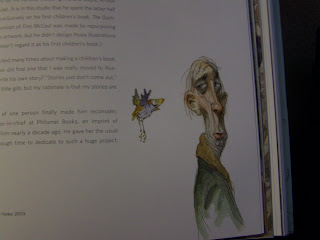
There are the rough sketches that lead to his New Yorker covers.

And some images from the brand new children's book, The Dutchess of Whimsy, that he is releasing with his wife.

There are probably over 400 sketches in the book and each of them is brilliant. Plus there is a wonderful introduction to Peter and his work. I was shocked to learn that he is color-blind. I can't imagine how he can paint without being able to see the watercolors he's mixing. The introduction includes some of Peter's artistic influences and some great quotes from other illustrators about his work. Overall this has to be one of the best book purchases I've made in decades. It makes me smile, it inspires me, and it is a treasure.

Sunday, January 24, 2010
Children's Book Canon
I posted this over on Yet Another Children's Book Blog but the book is too good not to share over here as well.

I'm normally not a huge fan of best of lists. Anytime you create a list of ten best, hundred best, or even 1001 best, you're going to have to leave some great books out. No list is perfect. But if I was looking for a pretty good canon of classic children's books, this would at least be a place to start. It has its missing titles, at least according to me, but it still has most of the books that I would consider must reads. I was fascinated by the width and breadth of the selection. And now have tons of new books to read.

I'm normally not a huge fan of best of lists. Anytime you create a list of ten best, hundred best, or even 1001 best, you're going to have to leave some great books out. No list is perfect. But if I was looking for a pretty good canon of classic children's books, this would at least be a place to start. It has its missing titles, at least according to me, but it still has most of the books that I would consider must reads. I was fascinated by the width and breadth of the selection. And now have tons of new books to read.
The book, 1001 Children's Books You Must Read Before You Grow Up, covers children's books for every age group and from around the world. The book is broken up into something of age groups: 0-3, 3+, 5+, 8+, and 12+. Some of these are a little arbitrary with books like The Jungle Book appearing in the under 5+ section, the same section that housed Are You My Mother? and Blueberries for Sal. But then again I'm not a huge fan of age categorization of books anyway. I know that when I was young I was interested in books that were well above my age level. I'm sure there are kids in the same situation. Each title is reviewed with a plot summary and some information about either the history of the book or what made it great. There are a number of guest reviewers including authors like Margaret Atwood, Nick Butterworth, Judy Blume, and Lois Lowry. Contributors range from educational authors, librarians, journalists, and critics. The book itself is edited overall by Julia Eccleshare
In each age section, titles are presented chronologically. I was shocked at how old some of the classic titles are. We all know that Aesop's Fables are very old but I had no idea that The Swiss Family Robinson was actually written in 1812. The books continue up until mostly modern day with the newest title being the 2008 release of The Graveyard Book. Unlike other canons of children's literature, this list contains books from around the world and many that are not written in English. I went through the book several times and was amazed by the number of German and French titles that appeared. These are books that I'd never heard of. Yet in their own countries they are classics.
I consider myself somewhat well read when it comes to children's books but I have to admit that I probably have read less than half of the titles. I have read many of the 3+ and 5+ but many of the 12+ have escaped my notice. I'm not sure if I simply bypassed that age group or that that there were far more foreign titles in that section and I rarely expanded my reading beyond primarily English titles. I will be curious to see how many of the foreign titles I will be able to get my hands on. My plan is to attempt to read all 1001.
As I mentioned before I'm not a huge fan of lists. As I went through the book I could think of a few titles that had been excluded that I would consider classics. The list is a little light on the modern side. But one of the strengths of the book is that the editor is aware that she cannot include all the books that would be considered classics. This is solved by including additional titles at the base of some of the reviews. At the bottom of the review of Seuss's The Cat in the Hat is a listing of other books by Seuss. Similarly at the bottom of the review of The Happy Prince by Oscar Wilde is a list of other stories about princes. This book may well be one of the most well defined canons for the children's literature genre. I guarantee that readers will find old familiar favorites and exciting new books to check out.
Monday, August 24, 2009
Ender's Game

Of course last week I didn't write anything about anything because I was reading Ender's Game and that was filling all my time. I finished Ender's Game Friday night but couldn't write about it. It was too fresh, too powerful. I just wanted to bask in the wonderfulness that is the book. Saturday I got entranced by a new art blog lines and color and of course had to go through the nearly 5 years of archives to find artists I like. I filled four notepad pages with just artists names who's work I want to explore. This meant that I had no time for writing a review. Today I'm back at work and suddenly feel like writing. So without further ado, Ender's Game.
Mention the book Ender's Game by Orson Scott Card to almost anyone who's read it and their eyes will light up. When I mentioned I was reading it, I had a ton of people who told me how much they loved the book. And I can see why. The story follows Andrew "Ender" Wiggins, a young boy who could be the greatest military strategist of all time. At least that's what the government thinks. At six years old he is taken from his family to train on battle strategy games. The commanders set him up as the greatest, alienating him from his classmates, and Ender performs. He rises quickly to the top of his class and graduates well early from the Battle School he attends. At 11 he is moved from Battle School to Command School and is trained on a simulator. He quickly proves himself to be the best at the simulator winning every battle against the alien species called "buggers". But the game is driving him crazy. I won't tell you the ending. Somethings are best discovered individually. But they real question is whether Ender's fragile psyche can hold out long enough for him to lead the troops into battle.
This book was a stunning and somewhat brutal looking into a military society. Ender, young and sensitive, is driven to the point of madness by commanders who are trying to see if they can crack the boy. They need to prove that he is the best general ever but watching them push this fragile young boy is very painful at times. The moment Ender gets comfortable and becomes happy, he is moved from his situation. He is never allowed to keep friends for any length of time and must fight his own battles, often with his own survival at stake. And all the time the military watches him. The description of the battle games, particularly the zero-gravity games, was fascinating. Ender's strategies are constantly evolving and we are given a chance to see his brilliance regularly. But we also see how much pain he is being caused.
I actually picked up this book at Jeff's insistance. He had picked it up last time we were at the bookstore and when he was finished, had left it on the table for me with one simple word. "Amazing". I couldn't agree more. Card's writing is fast paced and this book flew for me. Of course that could be because I couldn't put it down. I was interested in the school strategies and the interactions between the students. I grew to love the character of Ender and hate the military commanders. I cried at the end for reasons I won't disclose. This book touched me and angered me and thrilled me. A wonderful combination of action and emotion. And one of the best SciFi novels I have read in a long time. The next time someone mentions that they are reading Ender's Game, my eyes will light up and I'll start spouting about how much I loved the book.
Tuesday, July 28, 2009
Kushiel's Dart
I will start by saying that I almost never re-read books and I don’t read series. There are only two books in my entire library that I have ever re-read, Pride and Prejudice and Siddhartha. My reasoning is that there are way too many new books that I want to read and I have a good memory for things I’ve read before. As for series, I will read the first book of a series but almost never continue on to the next book. Series are a huge time commitment and I tend to have plenty of other books waiting to be read. So when I tell you that I finished Kushiel’s Dart and immediately wanted to re-read the book you’ll understand how significant that is. I’m also debating heavily whether or not I want to continue with the series. I don’t remember the last time I was this seduced by a book.

Seduced is an apt word for this story. Kushiel’s Dart, by Jacqueline Carey, is filled with intrigue, adventure, and romance with some steamy sex scenes. The story follows Phedre, a courtesan/spy who starts the book working for a nobleman to gain political information. Phedre is unique in that she experiences pain as pleasure (a masochistic prostitute), denoted by a mark in one of her eyes called Kushiel’s Dart. She uses her unique seductive skills to learn information which she then passes on to her benefactor. But Phedre and her benefactor are betrayed. He is killed and she is sold (along with her bodyguard Joscelin) to a tribe of barbarians as slaves. While there, she uncovers a plot to overthrow the Queen of Terre D’Ange (her home) and Phedre and Joscelin escape to warn her. The Queen decides that an alliance between Terre D’Ange (France) and Alba (England) would save the country from the invaders, and sends Phedre and Joscelin to Alba to return with the king and his army. On the way they must persuade Dalriada (Scotland) to lend its aid, gain safe passage from the Master of the Straits, and get back to Terre D’Ange before the invaders. I’m leaving out half the book practically with this plot summary but so much happens in this thick book that it would be impossible to list it all.
I want to talk for a moment about the setting before anything else because it affects so much of the rest of the book. The story is set in Terre D’Ange which is an alternative Renaissance France. A religion of sorts dominates the lives of the people, denoting where their position in society will be. Phedre is sold to a benefactor at a young age because her parents cannot take care of her. She is trained as a Servant of Naamah (a goddess of sex) but also follows Kushiel (a god of pain and destruction). Each of the characters has their role in society because of the god they are most aligned with. Joscelin is a Cassiline Brother, a priest who is trained from birth to protect. He is skilled in weapons and lives the ascetic life of a priest. So there is considerable friction between him and Phedre because of their different roles in society. Terre D’Ange is the wealthiest country and also the most beautiful in the invented world. Because of their wealth, they are often focused on politics, fashion, and pleasure.
There are so many characters in the book that at times they are tough to keep track of. Carey provides a detailed character list which helped greatly and the main characters are easy to keep straight. Phedre and Joscelin are the focus of the book and I really felt like I got to know the characters over the course of the book. So much happened and the characters grew so much that when I finished the book I wanted to go back to the beginning to watch the progression again. I wanted to see them again with the knowledge of what they would become. The book jacket gives you very little idea of the plot and when the benefactor was killed I was shocked since it was so early in the book. In fact I was surprised by almost every twist and turn. I had no idea what to expect and each adventure seemed to just breed more adventures. It was hard to put the book down since it seemed that there was a climax every couple of chapters. Speaking of climaxes there is plenty of interesting sex in the book since Phedre works as something of a prostitute for the wealthy. If you are turned off by submissive behavior or pain in sex this may not be the book for you but I found the scenes steamy but understated. This is not a Story of O, and everything is done very tastefully. And the sex is often overshadowed by the political intrigue which fills almost every page of the book.
There is an incredible diversity of characters and places in the book which makes for a very fleshed out setting. Carey creates a complex world, and fills it with interesting characters. It has been years since I loved a character but I loved the character of Joscelin so much that I had to skip to the end to see if he survived. I didn’t want to be surprised by his death. Both he and Phedre are the main focus of the book and Carey breathes life into both of them, creating complex and interesting characters. The relationship between them evolves beautifully after all that they have been through and we see that progression. The dialogue in the book is wonderful, filled with things unsaid and undercurrents. The setting is interesting and beautiful, and the characters are well written. The book was exciting enough to make me ache to know what happens, long enough to make me feel that I knew the characters, and steamy enough to leave me wanting more. A great read and an incredible story. Perhaps I will have to pick up the second.
Seduced is an apt word for this story. Kushiel’s Dart, by Jacqueline Carey, is filled with intrigue, adventure, and romance with some steamy sex scenes. The story follows Phedre, a courtesan/spy who starts the book working for a nobleman to gain political information. Phedre is unique in that she experiences pain as pleasure (a masochistic prostitute), denoted by a mark in one of her eyes called Kushiel’s Dart. She uses her unique seductive skills to learn information which she then passes on to her benefactor. But Phedre and her benefactor are betrayed. He is killed and she is sold (along with her bodyguard Joscelin) to a tribe of barbarians as slaves. While there, she uncovers a plot to overthrow the Queen of Terre D’Ange (her home) and Phedre and Joscelin escape to warn her. The Queen decides that an alliance between Terre D’Ange (France) and Alba (England) would save the country from the invaders, and sends Phedre and Joscelin to Alba to return with the king and his army. On the way they must persuade Dalriada (Scotland) to lend its aid, gain safe passage from the Master of the Straits, and get back to Terre D’Ange before the invaders. I’m leaving out half the book practically with this plot summary but so much happens in this thick book that it would be impossible to list it all.
I want to talk for a moment about the setting before anything else because it affects so much of the rest of the book. The story is set in Terre D’Ange which is an alternative Renaissance France. A religion of sorts dominates the lives of the people, denoting where their position in society will be. Phedre is sold to a benefactor at a young age because her parents cannot take care of her. She is trained as a Servant of Naamah (a goddess of sex) but also follows Kushiel (a god of pain and destruction). Each of the characters has their role in society because of the god they are most aligned with. Joscelin is a Cassiline Brother, a priest who is trained from birth to protect. He is skilled in weapons and lives the ascetic life of a priest. So there is considerable friction between him and Phedre because of their different roles in society. Terre D’Ange is the wealthiest country and also the most beautiful in the invented world. Because of their wealth, they are often focused on politics, fashion, and pleasure.
There are so many characters in the book that at times they are tough to keep track of. Carey provides a detailed character list which helped greatly and the main characters are easy to keep straight. Phedre and Joscelin are the focus of the book and I really felt like I got to know the characters over the course of the book. So much happened and the characters grew so much that when I finished the book I wanted to go back to the beginning to watch the progression again. I wanted to see them again with the knowledge of what they would become. The book jacket gives you very little idea of the plot and when the benefactor was killed I was shocked since it was so early in the book. In fact I was surprised by almost every twist and turn. I had no idea what to expect and each adventure seemed to just breed more adventures. It was hard to put the book down since it seemed that there was a climax every couple of chapters. Speaking of climaxes there is plenty of interesting sex in the book since Phedre works as something of a prostitute for the wealthy. If you are turned off by submissive behavior or pain in sex this may not be the book for you but I found the scenes steamy but understated. This is not a Story of O, and everything is done very tastefully. And the sex is often overshadowed by the political intrigue which fills almost every page of the book.
There is an incredible diversity of characters and places in the book which makes for a very fleshed out setting. Carey creates a complex world, and fills it with interesting characters. It has been years since I loved a character but I loved the character of Joscelin so much that I had to skip to the end to see if he survived. I didn’t want to be surprised by his death. Both he and Phedre are the main focus of the book and Carey breathes life into both of them, creating complex and interesting characters. The relationship between them evolves beautifully after all that they have been through and we see that progression. The dialogue in the book is wonderful, filled with things unsaid and undercurrents. The setting is interesting and beautiful, and the characters are well written. The book was exciting enough to make me ache to know what happens, long enough to make me feel that I knew the characters, and steamy enough to leave me wanting more. A great read and an incredible story. Perhaps I will have to pick up the second.
Wednesday, May 13, 2009
Thunderbolt Kid

I'm apparently on a Bill Bryson kick. Last week I read Shakespeare: The World as Stage and this week I just finished Life and Times of the Thunderbolt Kid. I think I've read all of Bryson's books now and have enjoyed every single one of them. One of the better humor/travel writers of our times. I learned a lot from the Shakespeare book but I laughed a lot more with Thunderbolt Kid. While Shakespeare took me a couple days to work through, Thunderbolt Kid was gone over the weekend. I couldn't stop reading it.
Bill Bryson tells a hilarious story of growing up in the 1950s in Des Moines. As a Des Moines native myself this book is wonderful for all the great history. I know many of the places he talks about. The downtown Younkers building that he speaks of so affectionately was where I had my first job out of college. And not on the sales floor. I was working up in advertising and got to spend a lot of my time in the bowels of the building. It was an interesting building. Many of the streets he talks about are my current daily commute. (Grand or Ingersoll) Some of the houses he mentions in the South of Grand area are still standing. Some things may have changed but some things (like my love of Bishops cafeteria) will never die.
But the book is not just Des Moines history. This is the story of Bryson's family but also about the outside world in general. His discussion on nuclear energy and our plans for it in the fifties are enough to make me cringe and laugh at the same time. As he puts it, we were apparently indestructable. I guess at one point the government was even looking into rocket mail delivery. This was the time when some of my favorite SciFi writers were really ramping up. Space travel, Mars colonies. Bryson describes all of the scientific fever of the day brilliantly.
The Thunderbolt Kid was Bryson's alter ego in the book. A superhero who develops x-ray vision for the purpose of looking under clothes. (and even removing restricting clothing) The fact that it can vaporize annoying people was just a side bonus. So Bryson goes through the book vaporizing stupid people, growing up, and exploring his city. So much of this book was laugh out loud funny. His stories about his family were odd and wonderful but I could also identify with them. All families are quirky in their own way. One of his closing stories, about a bomb one of his friends built, had me literally on the floor laughing. This book is a love story to a changed city but also a humorous reflection on what it meant to be a kid in the fifties. Well worth a read.
Thursday, December 18, 2008
Just One More Book
I'm passionate about children's books. When I was young I was in love with picture books. As I grew older I moved to chapter books. And now that I'm an adult I love them both. I still pick up the occasional chapter book but it is really picture books that bring me back to the children's section. The blending of words and illustration is just magical to me. So many of my favorite books were picture books. Arnold Lobel, Maurice Sendak, Dr. Seuss, Robert McClusky, P.D. Eastman...etc were the guides of my childhood and the passion of my adult life. And I'm constantly on the lookout for more stories.
So when one of my favorite blogs (Seven Impossible Things Before Breakfast), pointed out a children's book podcast, I had to check it out. And I'm so glad I did. Andrea Ross and Mark Blevis have created the podcast "Just One More Book". The two, who are married, sit down before work at their favorite coffee house and review the books they and their children love. They interview authors, illustrators, and agents. And they are one of the strongest voices in the kid's lit world. The podcast comes out regularly and is available free through iTunes or through their website, among other spots. They give a summary of the story, discuss their reactions to the book, and talk about why it works. They do not review books they don't like.

The passion these two have for children's books is contagious. I have been listening to the backlog of podcasts from the website at work. And I've been really excited about checking out the stories they have mentioned plus many others. I find that there are a ton of books out there that I simply don't know about. Sites like Just One More Book or Seven Impossible Things... remind me of all the new and unique books and artists that are out there. Then I hit the library and gather as many as I can. The ones I love I'll eventually purchase. I like having my own little library to lend from.
So I have two requests for you my dear readers. First, if you enjoy children's books listen to an episode or two of Just One More Book and see what you think. It's free and lots of fun. My second request is because of an old curiosity I have. Whenever I am trying to get to know someone I always ask two questions. The first is name two places you have always wanted to travel to. And the second is name your favorite children's book. So I extend that invitation, the same way Mark Blevis does at the end of every podcast. Tell me what your favorite kids books is. And in a post next week, I'll list mine.
Monday, December 15, 2008
Book Review: Lolita

When Vladimir Nabokov published his controversial novel in 1955 it was in Paris, not in the U.S. where he had been living for some time. The novelist had published nine novels in Russia before moving to the US. No American publisher would touch the novel calling it salacious and filthy. Today it is a regularly banned book and still incites controversy whenever it is read.
I'm not sure where I picked up a copy of the novel. It has been listed as one of the greatest books ever written and among the most disgusting. As a big believer that books, of all natures, should be read I decided that I had to choose for myself which category it best fit into. I had originally planned to read the book for Banned Book Week in September but was busy and didn't pick it up until early November. Even with that it took me almost a month to pull through.
The story of course, for those who don't know, follows Humbert Humbert as he lusts after his 12 year old step-daughter. Humbert has a particular fancy for young girls (10-14) which in now days society would have him listed on the sex offender registry in every state. He meets Lolita with her mother at their home, manages to marry said mother, and then when the mother is killed picks up his "daughter" and abducts her on a cross country trek.
While Nabokov's prose style is tough the book is very well written. But that, for me, didn't make up from the fact that it is not an easy subject matter to read. This story is basically the repeated rape of a young girl told through the eyes of her rapist. While I am not shocked by the contents nor would I discourage anyone from reading the book, it will not go on my best books of all time list.
Nabokov's true strength in this novel is the use of narrator. By having Humbert narrate his own story we get a chance to see more clearly the mind of a pedophile and rapist. Even Humberts attempts to justify his behavior make him more hated to the reader. Nabokov has created an anti-hero to rival Alex from A Clockwork Orange. This is the most powerful part of the novel. While Nabokov said that he never wrote moralistic fiction, there is a distinct moral to the novel as Humbert goes to meet the man that pulled his Lolita from him. Humbert, when confronting him, calls the man a rapist and defiler and I defy any reader to not see the exquisite irony in those words.
Voltaire is attributed as saying "I disapprove of what you say but I defend to the death your right to say it." (the quote was actually made up by a later author but attributed to Voltaire's attitude) But this quote works perfectly for my opinion on this piece. I disliked the subject matter of the book, enjoyed the writing, and was mildy ill while reading but I will never say that people can't or shouldn't read this book. It is powerful in many ways and well worth reading. Just be warned that this will create some pretty strong emotions, in yourself and others.
Wednesday, November 19, 2008
Book Review: Nature Girl

I love Carl Hiaasen. Okay well I've never met the man but I love his writing. There is something about the ability to take a dozen or so oddball characters and weave them together into a hilarious story. When I first read John Irving I thought that he was the best at combining characters but Hiaasen takes it to a higher place. This book is filled with no less than a dozen characters who are all fascinating in their own right. And he manages to bring them all together on one small island to see what will happen.
Nature Girl follows Honey Santana, a single mom in the Everglades who is off her meds. She hears mismatched songs in her head constantly and reacts often violently when things displease. Well she is displeased when a telemarketer calls one evening and then calls her a name. So she sets about to track him down. Now the telemarketer is having an interesting week as it is. His mistress is about to dump him for being too boring, his rich wife is planning to divorce him, and a private investigater is tailing him. So when he gets a fake call from Honey offering him an ecotour in Florida he jumps at the chance. So the telemarketer, his mistress, and the private investigator all head down to Florida.
There they meet a Seminole Indian who is haunted by a tourist he didn't kill, a college girl who is bored with life and is just looking for something fun, a fish vendor who is stalking Honey, and Honey's ex-husband and son. And that's just the beginning. Imagine all of these on a small island to get an idea of the almost slapstick quality of this novel. He sets things up beautifully. There are so many kidnappings in this book it is hard to keep track of whose prisoner is whose. Each character is played up to the max. Boyd, the telemarketer, is just scum in the worst sense of the word. Honey is crazy but still very likable. Sammy, the Seminole Indian, just wants to be alone and can't seem to catch a break. Even Boyd's soon to be ex-wife is just a little crazy.
Hiaasen writes all of his books about Florida and particularly about wild Florida. When I was on vacation a couple weeks ago I read his The Downhill Lie, about golf. I'm always impressed with the subtle environmental message that he hides in his books. The bad guys hate the outdoors, the good guys revel in it. The swamp always wins. And these are hidden in the book. Anyone who reads his work will come away thinking about how hilarious a writer he is. They may not even notice any sort of message. The plot on this books is wild but somehow the reader is willing to follow. The characters are just too interesting to turn away. In the tradition of the best train wreck, we just have to keep looking.
This book was a perfect antidote for me. It has been weeks since I've done any real reading so this was a quick read filled with enjoyable characters. I devoured it in little over 24 hours. The perfect beach book, I could also see spending a cold snowy day curled up on the couch with this book. Just be careful who's in the room. I guarantee you will laugh, probably out loud, possibly shooting food out your nose. Yeah he's that funny.
Monday, October 13, 2008
Mrs. Frisby versus Mrs. Brisby

I loved the Secret of NIMH as a child. I watched it over and over. I had the movie storybook. It had cute talking animals that were intelligent and civilized, what more could I want? To be completely truthful I think my young mind had a bit of a crush on Justin, the captain of the guards. Bear with me, I was young. I had always meant to read the book but never seemed to get around to it. It was similar to so many of those books that I should have read as a child but didn't.
So this past week I picked up the book and finished it in a day. The book actually is called Mrs. Frisby and the Rats of NIMH by Robert C. O'Brien. The character is changed to Brisby in the film. Like the Wind in the Willows, this book is a treasure. The story is engaging, the characters are likable, and the description of the farm and the rats is even more vivid then the film. This is book I would recommend. As a children's story it has some interesting themes of animal experimentation (although not portrayed as a terrible thing in the book), stealing, civilization, and the power of knowledge.
I decided after finishing the book that I should watch the movie again. I own it so after the Boston/Tampa Bay game I popped in the DVD. And about halfway through I knew it was a mistake. The film is awful. Seriously terrible in comparison to the book. The book offers a more realistic view of the rats, a realistic view of the other animals, and the biggest difference there is no magic. If you remember the mouse's home is finally moved by Mrs. Brisby using the "sparkly" that Nicodemus gave her. In the book there is no magic amulet. There is no annoying crow character. The character of Jeremy, the crow is wise and sensible, except when it comes to shiny things.
The character of Mrs. Frisby is also very different from the character of Mrs. Brisby. The character in the book is driven to heroics. She may not be the bravest mouse but she knows what she has to do and does it. She thinks constantly of her children and uses her worry for Timothy as a strength. The character in the movie is instead simpering, afraid, and pushed into situations. She is not brave and seems very helpless. She is often pleading for help. The character in the book helps herself and often attempts to help the rats.
The plot between the book and the movie shares some common elements but the majority of it is different. There is no Jenner looking to overthrow the rats society. Jenner and his comrades have left the colony a while ago and do not return in the book. This drama between Nicodemus and Jenner makes up the majority of the second half of the film. The plan to leave the rosebush is similar but the thought that has gone into it is different. The book goes more into the history of the rats after they escape from NIMH and how they started using tools. And the end is tragic and wonderful at the same time.
I was shocked and saddened watching this movie. The book is a treasure and the movie turned it into a slapstick comedy and a magical fantasy. I actually came away thinking that maybe the movie shouldn't have been made. This is unusual. Normally the first version of something tends to be my favorite. For books and movies, if I see the movie first I normally like the book and movie equally. If I read the book first it is always better. One of these years I'll remember to just read the book.

Tuesday, September 9, 2008
Book Review: The Lightning Thief

Last week or so I posted a blog post about how my nephew had asked me what books I was reading. I mentioned that he had made a recommendation himself. What he recommended was The Lightning Thief by Rick Riordan. So of course I had to read it. And I'm so happy I did.
The premise is so familiar. A young boy finds out that he is not like the other kids in his class. He is magical. He is taken away to a special place to be trained in his abilities. I know what you're thinking. I've read this story before. But you haven't. Percy Jackson, the main character, is not magical and he is certainly not Harry Potter. Instead he's a demigod. The story goes that the Greek gods are still living and have moved to America, they tend to live in the most powerful western nation. The gods are up to their old ways, controlling the weather, creating wars, and seducing humans to create offspring. Percy is a son of one of the gods. (I won't tell you which one but it's pretty easy to figure out.)
He is taken to Half Blood Hill, a summer camp for demigods, to learn about his powers and to keep him safe from the monsters that are trying to kill him. (think Medusa, Minotaur...) At the camp he is surrounded by others like him. The camp is really set up interestingly and the book is well worth reading for the descriptions of the camp and the way the god's children reflect their tendencies. Athena's children are smart and excellent strategists, Hermes children are fast, and Ares children tend to be boorish and violent.
But Percy doesn't stay at camp long. War is breaking out between the gods and only he can stop it. With the help of a clumsy satyr and a child of Athena, Percy sets out to the west coast, battling monsters to stop the war. The references to Greek mythology are wonderful and very entertaining for adults. I'm not sure how young adults will view this if they are not familiar with some of the stories. I will say that having the background knowledge does actually make the story a little less suprising. The discovery that one person is a monster has been hinted at so much that it was well known to me. But for young adults and children these may still be surprises. And perhaps the prior knowledge helps with the suspense.
Many people have discussed how the series (there are several Percy Jackson books) are like the Harry Potter series. There are some similiarities to the Harry Potter series. Percy is a gifted student who often acts in a way that would get other kids in trouble. He is insulent to the gods and has an almost fearlessness in the face of danger. (He tells Hades off. That takes guts) His companions include a helpless, always hungry satyr Grover who tends to mess up regularly and a brilliant girl who also has the power of invisibility.
But this is a very different series with a very different tone. The Lightning Thief has a much lighter tone than the Harry Potter series and is willing to play a bit more between regular people and the god world. While Harry is confined almost completely to the magical world (after the first 40 pages) Percy must interact with the populus. Percy has a human family as well. His mother, who Percy adores, has protected him over the years by sending him to private schools, which he flunks out of. His stepfather is a terrible man who Percy can't stand. The dynamics between the three of them are almost painful. Not because they are not well written but because I has seen families like this.
I actually learned quite a bit of mythology through this first book. The depictions are hilarious. I adored the depictions of Charon (who ferries souls across the river Styx) and Cerberus. And with chapter titles like "Three Old Ladies Knit the Socks of Death" and "I Become Supreme Ruler of the Bathroom" this is much lighter more fun book. While the book is listed for young adults I found it just as enjoyable, perhaps more, than any child could. This is such an entertaining book I might break my rule about series and read the next one.
Thursday, August 21, 2008
Book Review: Team Rodent

It's a bit hard for me to write this review. I am quite a big Disney fan and an even bigger fan of Walt Disney World. But I try hard to be fair so I borrowed this book by Carl Hiaasen. The full title is Team Rodent: How Disney Devours the World and it is not the most flattering picture of the company. Hiaasen is not a fan.
Part of that seems to come from the fact that he lives in Florida, in a place taken over by Disneyfication. Hiaasen writes about the major destruction that has happened to the Florida environment since Disney moved in. And that I have to agree is true. Before Disney Orlando was a small orange growing community. Now those trees are gone, plowed under to make room for more and more housing. The sprawl in that city is terrible. Florida has grown by leaps and bounds, and that is painful for the environment. Point one for Hiaasen.
Disney is often held to a higher standard of behavior simply because they are Disney. And Hiaasen is quick to point that out. He is also quick to point out that they should be. They claim to be the ultimate family friendly place and it doesn't look so good when one of their employees acts up. And I have to agree with him there. Disney does a lot to cover up problems rather than deal with them outright. But even Hiaasen has to agree that there have been a lot of frivolous lawsuits for Disney just because of the money they have.
Hiaasen's big argument though is that Disney is gentrifying everything. He claims that they have destroyed Times Square by making it less seedy. Here is where he loses me. I have no problem with strip joint and bars but I am also pretty impressed with what the city has done with a corner that was not the most well traveled. I have no problem with the escapism that Disney helps to create. I'm going to sound old when I say this but manners and gentrification are not always a bad thing. I love to go to Disney world mostly because people are nice, the grounds are immaculate, and there are lots of things to do. Now I know that is not real life. It is escapism pure and simple. But I have a tough time believing that a little escapism is a bad thing. Sometimes it's nice to pretend.
All and all this was a very good book with a ton of great points. And of course Hiaasen tells it with humor and insight. I love his work. Perhaps if I lived in Florida I would have a different impression of Disney. But for right now I still don't mind the fantasy.
Subscribe to:
Posts (Atom)